The best pet photo is not always the sharpest one. It is often the frame that captures something unmistakably familiar: the head tilt, the way they wait by one particular door, or the paw that always lands on your arm.
To capture your pet’s personality in photos, start by observing rather than posing. Photograph the places, routines, expressions, movement, relationships, and small physical habits you already recognize. Technical clarity helps, but the real goal is a picture with enough context to tell a specific story.
Pet photography now spans a broad range of styles. The 2026 International Pet Photography Awards reported a record 4,220 entries from 48 countries, with categories ranging from phone photography and documentary work to action, portraits, and pets with people. That range is a useful reminder: there is no single correct way to make a meaningful pet photo.
You do not need an award-winning setup. You need to know what to notice.
Begin with five quiet minutes
Before opening the camera, watch your pet in a familiar place. Where do they settle? What makes their ears move? What happens when someone enters the room? Do they approach a toy directly, circle it, carry it, or simply lie beside it?
The RSPCA’s recent animal-behavior photography activity uses a simple sequence: observe how an animal moves, rests, interacts, or explores; capture more than one behavior; then describe what is visible. That is also a practical way to move beyond a generic portrait.
Keep your description literal at first. "Her ears turned toward the hallway" is more useful than deciding immediately what she was thinking. You can add your personal interpretation after you have recorded the moment itself.
1. Look for the expression your family knows
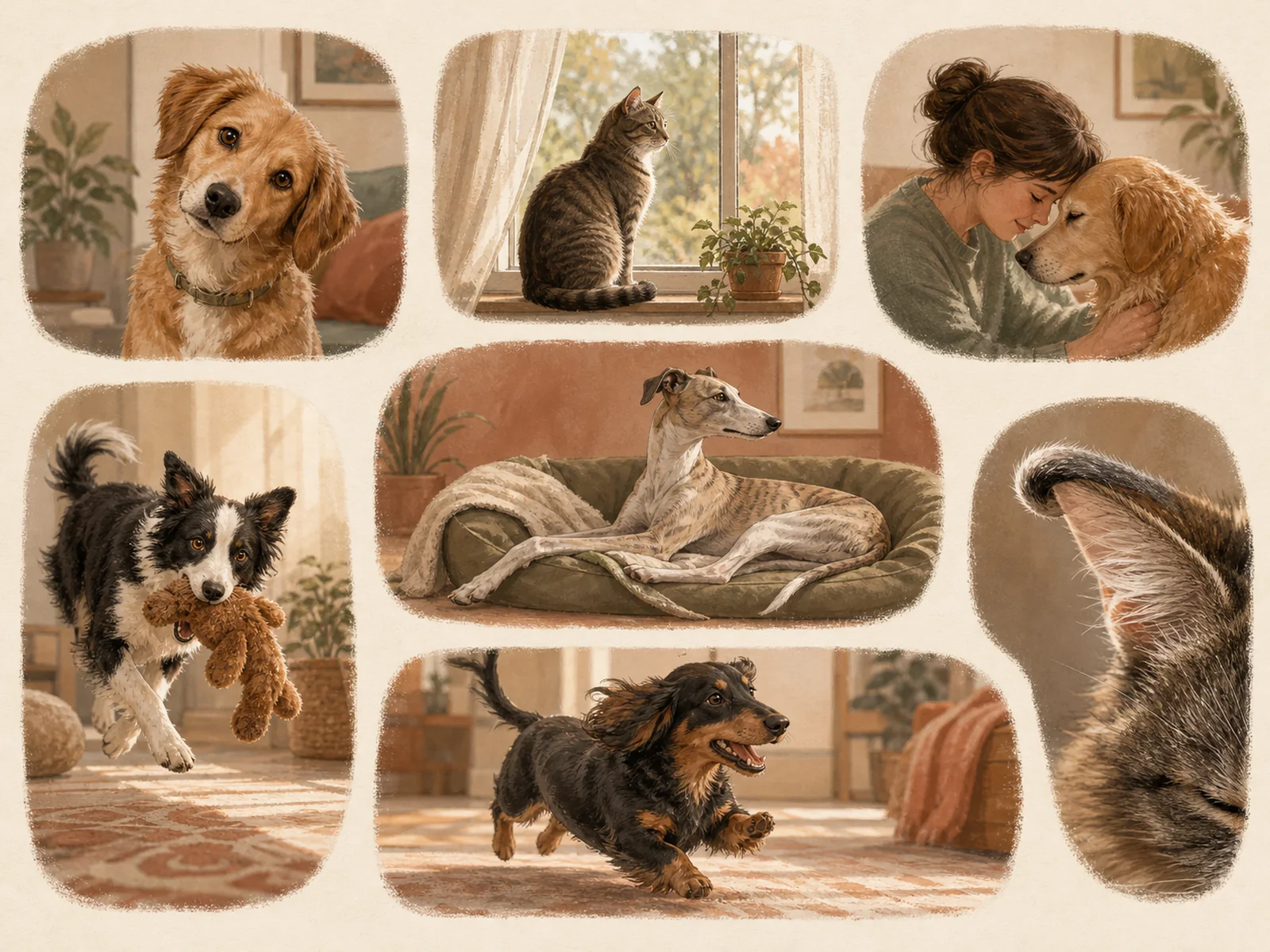
A stranger may see a dog looking sideways. You may recognize the exact look that appears before a walk. A cat’s half-closed eyes, forward whiskers, or slight head turn may feel more familiar than a perfectly centered stare.
Do not demand the expression. Put yourself near the place where it naturally happens and be ready. Take a short sequence so you can choose the frame in which the eyes, ears, mouth, and head position come together in the way you recognize.
Ask yourself: if the background disappeared, would this expression still feel like my pet?
2. Photograph an ordinary ritual
Routines carry personality because they repeat. Think about the few seconds before a walk, the chosen corner of the sofa, the inspection of a shopping bag, or the place where your pet waits while dinner is prepared.
Include enough of the room to show what is happening. A close-up may preserve the face, but a wider frame can preserve the relationship between the pet and the doorway, window, bed, toy, or person that makes the moment recognizable.
The routine does not need to look important. Its ordinariness is precisely what makes it personal.
3. Keep the relationship in the frame
Some pets show their personality most clearly around someone else. One may lean into a particular person. Another may sit exactly one cushion away. Two animals may share a window without ever touching.
Hands, feet, shadows, and the edge of another pet can be enough to tell that story. You do not always need a formal group portrait. The distance your pet chooses, the direction they face, and the way bodies mirror or contrast one another can say more than everyone looking at the camera.
Let the interaction happen at its own pace. If either animal or person wants space, the photograph can wait.
4. Make room for movement and mischief
Personality often appears between posed frames: the bounce before a toy is dropped, the sudden sprint across a rug, or the tail that sweeps through the edge of the picture.
Move back far enough to leave space in the direction your pet is going. Hold the phone or camera steady and make several frames rather than trying to time a single perfect instant. A little blur can still work when it communicates speed, enthusiasm, or comic timing.
The test is not "Is every hair sharp?" It is "Can I feel what was happening?"
5. Notice posture and silhouette
Recognition is not limited to the face. A long, elegant sit, a compact curl, a wide stance, a tucked paw, or a tail held in a familiar curve can make a pet identifiable from across the room.
Try one frame from the side or slightly behind. Photograph the whole body without cutting off paws or tail, then make a second, closer image. The pair can preserve both the overall mannerism and the expression.
This is especially useful for pets whose most characteristic moments happen while they are watching, waiting, sleeping, or moving away from the camera.
6. Record the detail other people might miss
Every family has its own visual shorthand: one ear that tips differently, a small patch on a paw, a whisker pattern, a curled tail, or the way fur parts above the nose.
Photograph the detail in context first, then closer. The wider image explains where it belongs; the closer image preserves it clearly. Together they are more useful and more meaningful than an isolated close-up without context.
7. Keep the imperfect frame
Do not delete every image with a crooked horizon, half-turned face, or slight motion blur. Technical mistakes and emotional mistakes are not the same thing.
If a photograph contains a gesture, relationship, or expression that may not happen again in quite the same way, keep it. You can make a cleaner image later. The imperfect frame may be the one that returns you most quickly to the actual moment.
Keep the session comfortable
A pet who repeatedly turns away, lowers their body, tucks their tail, hides, stiffens, or tries to leave is not asking for another take. For dogs, the RSPCA body-language guide includes lowered posture, avoiding eye contact, ears held back, and a tucked tail among signs of worry.
Know the normal signals of your own animal, keep the setting familiar, and stop when they have had enough. Never restrain, startle, dress, or repeatedly reposition a pet simply to get an image. A short, comfortable observation is more likely to preserve real behavior than a long session built around a pose.
Use the one-sentence test
When you have a group of possible photos, do not begin by asking which is most professional. Choose three and finish this sentence for each one:
This is so them because…
Your answer might be:
- "…they always bring the toy but never let anyone take it."
- "…this is the exact place where they wait for the door to open."
- "…one ear turns before the rest of the body does."
The strongest answer usually points to the strongest personality photograph. It also turns an image into a small story instead of leaving it as an unnamed file in a gallery.
If writing that sentence feels useful, the next step is to try the 25 pet story prompts or explore these pet photography ideas at home for more ordinary moments worth recording.
Build a three-photo personality set
One image does not need to do everything. A simple set can hold more of your pet’s character:
- The familiar look: a face or expression your family recognizes.
- The ordinary ritual: the pet doing something they regularly choose.
- The telling detail: a posture, relationship, or physical feature that completes the story.
Save the three images together and add one sentence to each. That small group is useful on its own, whether you keep it in a phone album, print it, add it to a memory book, or simply share it with someone who knows the pet.
If you later want an artist to understand the same details, the pet sculpture photo guide explains the practical views that complement a personality image. Include the story sentence with those references to explain why a particular expression or pose matters.
Tiny Presence creates custom pet sculptures from photos, but a meaningful photograph is valuable before it becomes anything else. Start with one frame and one honest sentence: "This is so them because…"