You do not need a studio, costume, or complicated theme to make a memorable photo of your pet. Start with the places they already choose and the moments that happen without being arranged: waiting at the door, watching from a window, carrying a toy, stretching after a nap, or settling near someone they trust.
The best at-home pet photographs often come from short, familiar sequences with a beginning, a middle, and an end. Photograph a sequence instead of demanding one perfect pose. You will have a better chance of preserving the movement, expression, and context that make the moment feel real.
Here are 15 ideas you can try with a phone or camera, using the home and routine you already share.
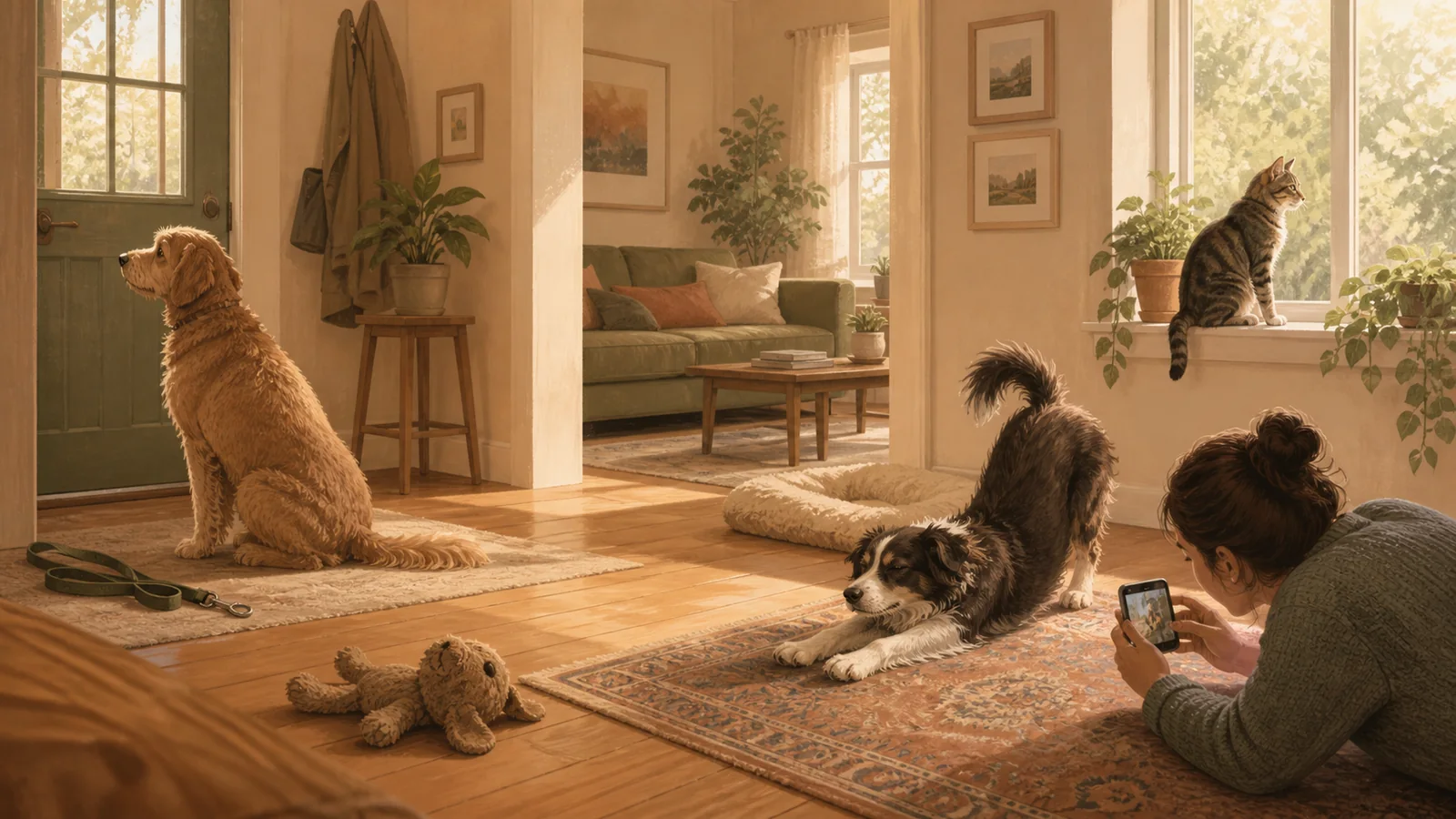
Before you begin: make the scene easy to read
Choose one familiar area and remove only the clutter that distracts from the story. Keep the pet’s bed, toy, blanket, bowl, doorway, or favorite chair if it belongs to the moment. Those objects provide context; a completely empty room may make the image cleaner but less personal.
Use available window light when it is comfortable, silence any startling camera sounds you can control, and move yourself rather than repeatedly moving the animal. Get low for some frames, but also keep a wider view of the room.
The RSPCA’s recent animal-behavior photography activity suggests observing an animal’s movement, rest, interaction, and exploration and capturing several different behaviors. That is the method behind this list: wait for a real moment, make a small sequence, and describe what actually happened.
1. The doorway wait
Photograph the few seconds when your pet realizes that someone may be coming home or that an outing may be about to begin. Include the door, mat, leash, or hallway, so the viewer can understand the anticipation.
Make one wide frame showing the setting and one closer frame of the ears, head, or paws. Do not open and close the door repeatedly to manufacture a reaction; use a moment that already occurs.
2. The favorite window
A window photograph can show attention, silhouette, and the small place your pet has claimed. Try a side view that includes what the pet is looking toward, then move slightly behind them for a frame that feels shared rather than posed.
Watch for reflections. Sometimes they add a second layer to the image; sometimes a small change in angle removes a distracting glare.
3. The pre-walk ritual
What happens before the walk begins? One dog may sit beside the leash. Another may circle, stretch, bring a shoe, or look between a person and the door.
Photograph the sequence before anyone rushes outside. The story is not simply "dog beside leash"; it is the particular way this dog prepares.
4. The chosen toy
Place several familiar toys where they normally live and photograph the one your pet chooses — if they choose one at all. The worn fabric, repaired seam, or unusual way the toy is carried may be part of the picture.
Avoid waving an object in the pet’s face for attention. Let the interaction belong to them.
5. The mealtime waiting place
Before food is served, many pets return to a consistent location or watch a particular person. Frame the pet with the relevant part of the kitchen or feeding area, while keeping food preparation and household safety first.
You do not need to delay a meal for the photograph. Be ready before the routine starts and make only a few frames.
6. The geometry of a nap
Photograph the shape your pet makes when completely settled: a perfect curl, a long stretch across two cushions, paws folded under the chest, or a head hanging over the edge of a bed.
Begin with the whole shape. Then record one small detail such as paws, ears, or the place where the pet meets the blanket. Do not wake or reposition them.
7. The after-nap stretch
The first stretch after rest is brief and full of movement. Choose a wider composition before it happens, so there is room for the body to extend. A short sequence will work better than trying to predict one exact frame.
Slight motion is acceptable if it preserves the length, curve, or energy of the stretch.
8. The under-desk companion
If your pet chooses to stay near you while you work, photograph the relationship between their resting place and yours. The edge of a chair, a foot, or a patch of desk light can establish companionship without turning the image into a formal portrait.
This idea works best when you do not interrupt the routine. Ask another person to make the photograph, use a timer, or take a quiet frame from where you are.
9. The household supervisor
Some pets watch laundry, cooking, gardening, packing, or repairs as if they are responsible for the project. Photograph their chosen vantage point and the safe part of the activity they are observing.
The humor comes from context. Leave enough of the scene visible for someone else to understand what the pet appears to be monitoring.
10. The shared window, sofa, or patch of sun
When two pets choose the same area, photograph the distance and arrangement they select. They may touch, mirror one another, face opposite directions, or maintain a precise gap.
Do not move animals closer for the picture. The relationship is visible in the space they choose, including the space between them.
11. The quiet moment after play
The end of play can be as expressive as the action itself: a toy dropped beside a paw, an open, relaxed posture, or two animals resting in different directions.
Make one image before the energy disappears. It can serve as the final frame in a three-photo sequence: ready, moving, resting.
12. The safe new object inspection
When a safe, familiar household object, such as a folded blanket or a newly moved chair, enters the room, photograph how your pet investigates from their chosen distance. Include the object and the approach path.
Never introduce something frightening or unsafe for the sake of a reaction. If the pet avoids the object, that is a reason to stop, not a reason to move it closer.
13. The weather-day spot
Rain, heat, winter light, or a breeze through a screened window can change where a pet spends time. Photograph the spot they choose and one clue to the weather: window droplets, a stripe of afternoon sun, or a blanket pulled into use.
Keep the image about a real adjustment in routine, not a seasonal costume.
14. The bedtime route
Instead of photographing only the final sleeping position, record two or three stages of the bedtime routine: the walk toward the room, a turn on the blanket, and the final place where the head rests.
Later, those small transitions may describe the evening more clearly than a single posed portrait.
15. The ordinary eye-level portrait
End with the simplest idea: sit or lie near your pet’s level in a place they already like. Wait until they look toward something naturally. Make one frame that includes the surroundings and one closer frame without demanding direct eye contact.
An ordinary portrait becomes personal when the expression and place belong to the pet, not to a temporary setup.
Know when the photograph is over
Photography should follow the animal’s comfort, not override it. For dogs, the RSPCA body-language guide lists lowered posture, avoiding eye contact, ears held back, yawning, and a tucked tail among signs that a dog may be worried. Learn the normal signals of your own pet and stop if they move away, hide, stiffen, or repeatedly disengage.
Do not restrain a pet, block an exit, use a startling sound, or keep repeating an action to obtain a reaction. The goal is not to prove that a pet can hold a pose. It is to notice the way they already move through their home.
Turn 15 ideas into one useful photo set
You do not need to complete the whole list. Choose three ideas that match your pet:
- one routine;
- one relationship or place;
- one movement or physical detail.
Afterward, select one image from each and add a sentence beginning, "This feels like them because…" The companion guide to capturing your pet’s personality in photos shows how expression, routine, relationship, movement, posture, detail, and even an imperfect frame can carry that meaning.
If you want to preserve more than the image alone, use one of these pet story prompts to record what happened just before or after the frame.
For readers who later want to use their photographs as artist references, the pet sculpture photo guide explains the practical face, side, full-body, and detail views that can complement these candid images. Tiny Presence also creates custom pet sculptures from photos, but the first step is simpler: notice one ordinary moment that could only belong to your pet.