Your Golden Retriever may carry a slipper from room to room and greet you with it as if returning something precious. That ordinary habit can feel like pure personality. It is also a small echo of a breed shaped in nineteenth-century Scotland to retrieve over wet ground and cold water. Yet the Golden’s origin is often told through a story that the surviving records do not support: a troupe of Russian circus dogs. The documented history is quieter and richer—one unusual yellow retriever, a now-lost water spaniel, a Highland estate, and a lineage shaped by decades of deliberate choices before it reached family homes around the world.
The short answer: where did Golden Retrievers originate?
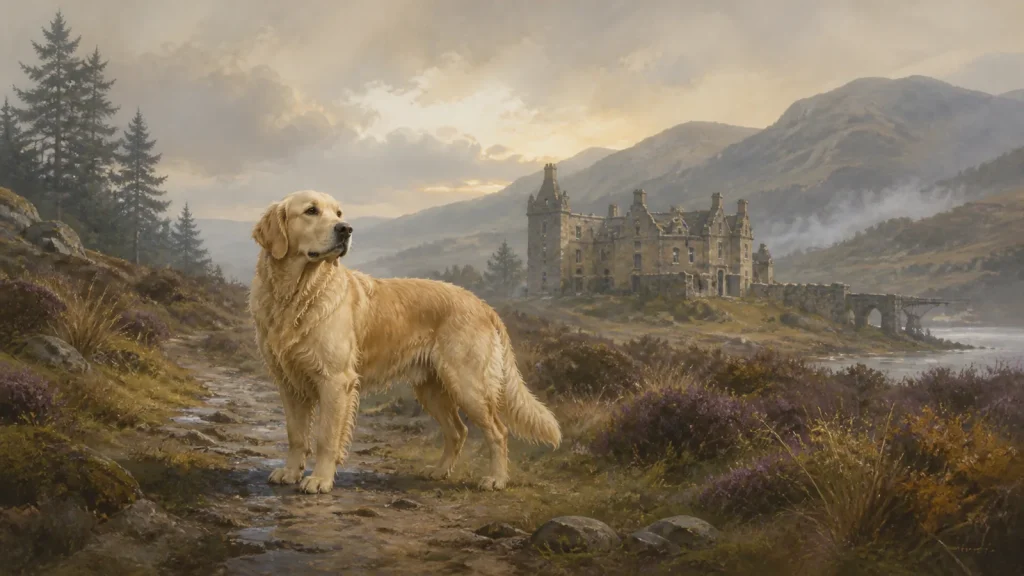
The documented Golden Retriever story begins at Guisachan, the Scottish Highland estate of Dudley Coutts Marjoribanks, who later became the first Baron Tweedmouth. The central recorded event was an 1868 pairing between Nous, a yellow retriever, and Belle, a Tweed Water Spaniel associated with Ladykirk on the River Tweed.
Their yellow offspring became a foundation for a longer breeding program. They were not a modern breed created in a single afternoon. Over the following decades, Marjoribanks and others bred, selected, and shared working retriever lines. Only in the early twentieth century did kennel organizations formalize the name by which we know the breed today.
That distinction matters. A foundation litter begins a documented line; recognition turns related dogs into an officially named breed. The Golden Retriever’s history includes both.
Before the Golden Retriever had a name
In nineteenth-century Britain, retrievers were working dogs rather than one fixed visual category. Their job was to find and retrieve shot game, often across difficult ground or water. Breeders paid attention to working ability, coat, size, color, and the qualities they wanted to preserve in later generations.
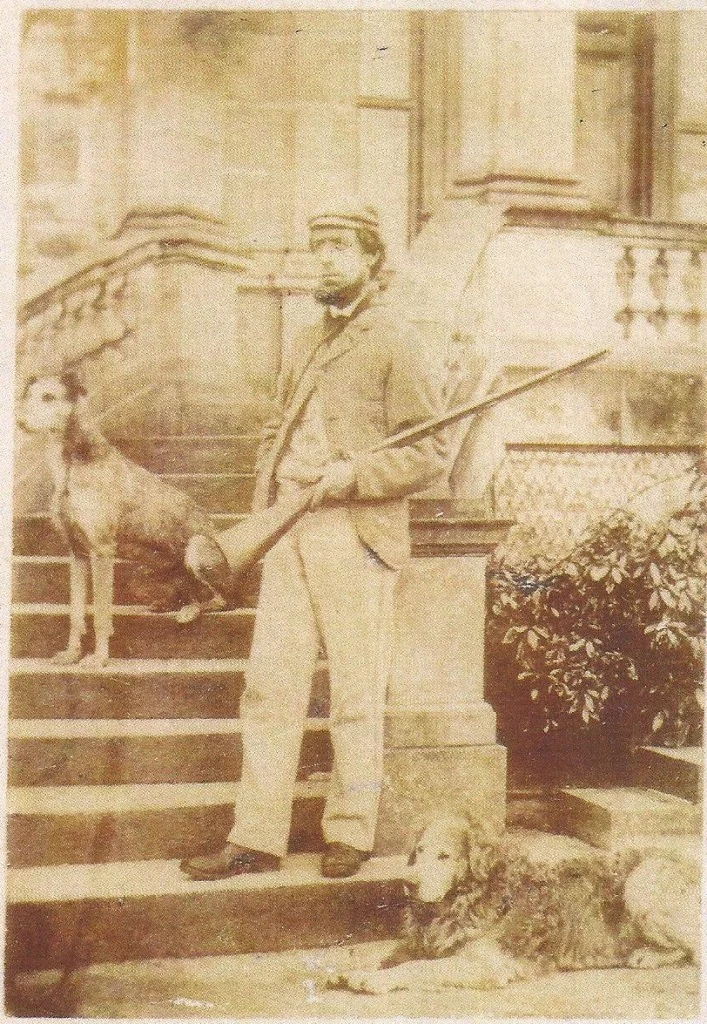
Guisachan gives historians something unusually valuable: records. In a 1952 Country Life article now preserved online by the Golden Retriever Club of America, the sixth Earl of Ilchester described a family studbook that Marjoribanks had maintained from 1835 onward. After Marjoribanks bought Guisachan in 1854, the kennel entries became more extensive.
The book did not answer every modern question, but it anchored names, pairings, and dates to a surviving record rather than a story repeated from memory.
Nous, Belle, and the turning point of 1868
Nous appears in the record by 1865, with an entry indicating that he had been purchased in Brighton the previous year. He was yellow at a time when black retrievers were more familiar and fashionable. Later retellings disagree about exactly how Marjoribanks found him, so the careful version stays close to the studbook: Nous was associated with Lord Chichester’s breed and purchased in Brighton in 1864.
Belle came from the Ladykirk line. Notes cited in the Ilchester article connect that line with Tweed Water Spaniels, a working water-spaniel type that no longer survives as a recognized breed. In June 1868, Nous and Belle produced yellow puppies. That pairing is the secure center of the Golden Retriever’s documented foundation.
It is tempting to turn those puppies into an instant modern breed. History is less tidy. Marjoribanks continued breeding and recording dogs for years, and the Golden Retriever Club UK describes the program as extending from 1868 to 1889. Later generations and additional working lines helped shape the dogs that would eventually be shown, registered, and named.

A small disagreement that good history should not hide
The 1952 Ilchester article describes four puppies in the 1868 litter: Cowslip, Primrose, Crocus, and Ada. More recent accounts from the AKC Library and Archives and Friends of Guisachan place Ada in a later repeat pairing of Nous and Belle.
That disagreement does not change the central conclusion: the 1868 Nous–Belle pairing was foundational. It does remind us that a historical account can be strong without being complete. Names copied into pedigrees, family recollections, and later archival research do not always align perfectly. Rather than force a false certainty, it is more honest to mark the branch where the sources divide.
The Russian circus story—and why it survived
For years, a more theatrical origin story circulated. According to the tale, Marjoribanks saw a troupe of large yellow Russian dogs performing at a circus in Brighton, bought the group, and used them to begin his line at Guisachan.
It is easy to understand the appeal. A traveling circus, rare foreign dogs, and a Scottish estate make a memorable beginning. The studbook made a different case. The entry for Nous places him in Marjoribanks’s possession before the supposed circus purchase and identifies him with Lord Chichester’s breed, not a Russian troupe. The surviving Guisachan pedigree record therefore does not support Russian circus dogs as the foundation of the Golden Retriever.
The Ilchester article does preserve one intriguing loose end: an otherwise unexplained dog named Sancho appears in an 1868 entry. Ilchester wondered whether Sancho might have helped create a later memory of a circus dog at Guisachan, but he found no role for Sancho in the yellow retriever pedigree. That is a clue about how stories may grow, not evidence for Russian ancestry.
The careful conclusion is narrow. The records do not support the Russian-circus foundation story. They cannot prove that no dog with a Russian association ever visited the estate.
The ancestor we cannot reconstruct with confidence
Belle is commonly described as a Tweed Water Spaniel, but the name can create a misleadingly sharp picture. The type disappeared, and even the 1952 historical investigation reported uncertainty about precisely what those water spaniels looked like. There is no complete modern breed standard waiting to be read backward into Belle.
This is one reason an illustrated history should label reconstruction as reconstruction. We can say that the Ladykirk dogs were associated with the Tweed Water Spaniel and that Belle’s contribution was central. We should not pretend to know every feature of her face, coat, or body from the surviving words alone.
The Royal Kennel Club’s current breed history also notes later Bloodhound and Irish Setter influence. Those additions belong to the longer development of the line, not to a simple two-dog formula for recreating a Golden Retriever.
From working line to officially named breed
As yellow retrievers moved beyond Guisachan through family, friends, keepers, and emerging kennels, they gradually became visible to a wider public. The Golden Retriever Club UK dates their first exhibition to 1908, before they had a separate, settled identity in the show ring.
Registry dates can look inconsistent when different accounts combine first registration, separate classification, club formation, recognition, and naming. For clarity, this article follows the current registry milestones:
- The Royal Kennel Club says the breed was recognized as a yellow or golden retriever in 1913.
- The same registry history says the official breed name became Golden Retriever in 1920.
- The American Kennel Club’s recognition list records
Retriever (Golden)under 1925.
By then, a working line developed on a private Highland estate had acquired a public name that could travel across registries, countries, and generations.
What the working past does—and does not—tell us about a Golden today
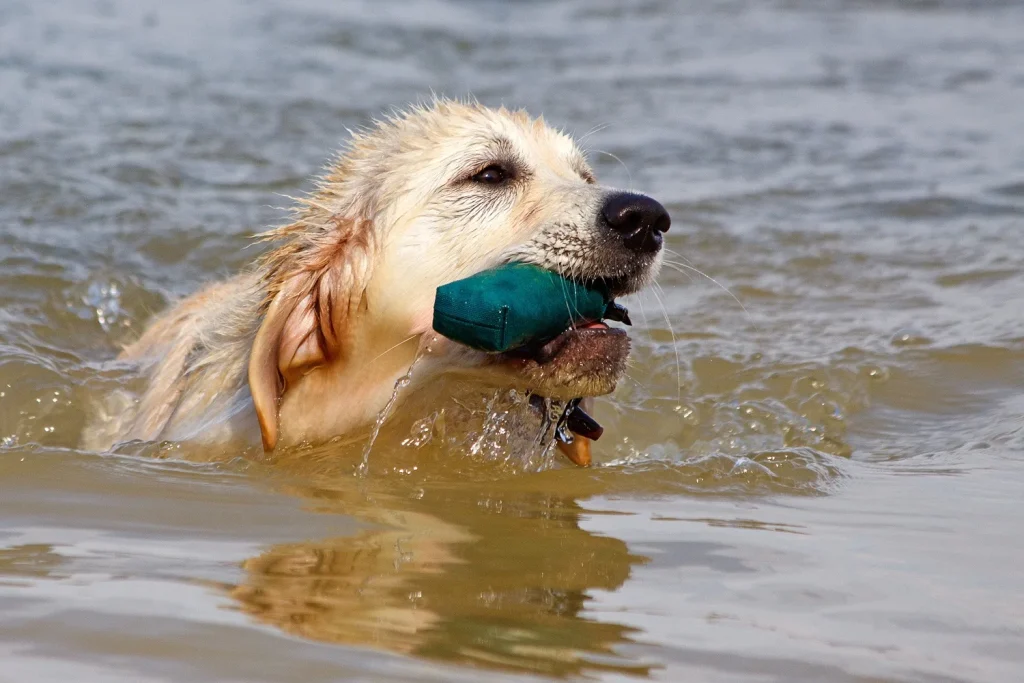
Knowing that Goldens came from retriever work can make familiar behavior feel newly connected. A dog who meets you with a toy, carefully carries a found glove, or searches the grass for a favorite ball may seem to be holding a thread that reaches back toward that working past.
It is a beautiful connection, but it is not a rule. Breed history offers context for tendencies that people selected over generations; it does not explain every action by an individual dog. Not every Golden loves water. Not every Golden carries objects. No historical summary can promise a particular temperament, relationship, or family fit.
What history can offer is a wider frame. The dog beside you belongs to a documented breed story, but they are not only an example of that story.
.jpg)
Your dog’s history is smaller—and more personal
A breed’s history survives in ledgers, club archives, registry decisions, and the work of people who question an old story. Your Golden’s history lives somewhere else: in the towel they steal, the place they wait at dinner, the toy they bring to the door, and the expression your family recognizes before anyone says the dog’s name.
Those details are worth recording because they are not contained in any breed standard. The pet story prompts can help you write one of them down without turning it into a formal biography.
If a single photograph preserves the shape of that individual story—the feathering around one ear, a familiar sitting posture, or the toy always carried at greeting—Tiny Presence can use it as visual reference for a custom dog sculpture. The aim is not to make a generic Golden Retriever. It is to preserve the particular dog a family knows. When you are ready, you can see the available sizes and pricing.
Golden Retriever history: quick answers
Where did Golden Retrievers originate?
Their documented foundation is associated with Guisachan, Dudley Coutts Marjoribanks’s estate in the Scottish Highlands.
Which dogs formed the foundation of the breed?
The key recorded pairing in 1868 joined Nous, a yellow retriever, with Belle, a Ladykirk dog identified in the historical notes as a Tweed Water Spaniel. Later breeding over several decades shaped the developing line.
Did Golden Retrievers come from Russian circus dogs?
No. The Guisachan pedigree does not identify a Russian circus lineage among the breed’s founders. The story was widely repeated before the family studbook and related records became available to researchers in the early 1950s.
When did the breed officially become the Golden Retriever?
The Royal Kennel Club’s current history gives 1913 for recognition as a yellow or golden retriever and 1920 for the official Golden Retriever name. The American Kennel Club lists Retriever (Golden) as recognized in 1925.
A history held in two kinds of memory
The Golden Retriever’s public history is unusually well documented, but it is not perfectly closed. A studbook displaced a romantic origin myth. Later researchers reopened a question about one puppy. The lost Tweed Water Spaniel still resists a confident visual reconstruction. Good history becomes more trustworthy when it tells us where the evidence ends.
Then there is the history no archive can keep: the ordinary life of one dog in one home. Perhaps it begins each evening with a Golden walking toward the door, carrying something soft and waiting for the person they know to return. The breed’s history explains part of the long journey to that moment. Love makes the moment their own.