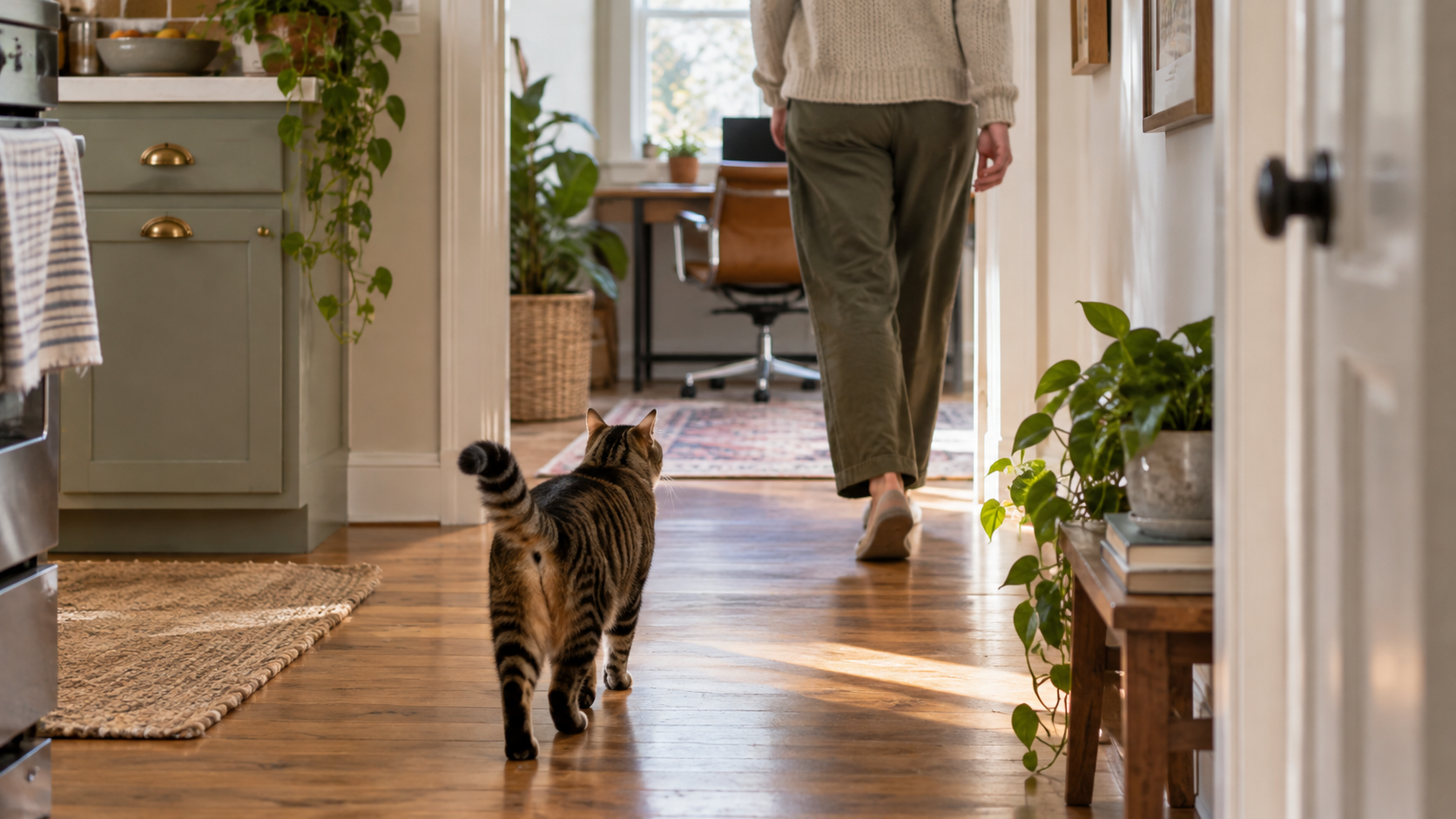
You stand up to refill your water, and your cat appears beside you. You walk to the kitchen, and a soft set of paws follows. Even the bathroom door may become a matter of household importance. It is endearing when it has always been part of your rhythm—and unsettling when the behavior suddenly changes.
The honest answer is that a cat who follows you does not have one universal message. The behavior may be social, curious, routine-driven, or connected to food, play, access, or reassurance. The most useful clue is not the number of steps behind you; it is what happens before, during, and after the following. This guide helps you read that familiar pattern without turning it into proof of love, anxiety, or illness.
In brief
- A calm, long-standing pattern may reflect routine, curiosity, social proximity, or a practical request.
- Following is not, by itself, proof of affection, anxiety, separation anxiety, or illness.
- A sudden, persistent change—especially alongside appetite, movement, grooming, litter-box, sleep, or vocal changes—deserves a wider look and, when appropriate, veterinary advice.
The short answer: look at the whole sequence
Many cats follow their people because the person is part of the cat’s social world and daily map. Your movement may predict breakfast, a favorite toy, an open door, a warm bed, or simply a change worth investigating. Some cats want to share a room while keeping control over physical contact. Others have learned that walking behind you reliably leads to attention or a resource.
Following can also become more noticeable after a change in the household. A new schedule, visitor, move, blocked route, or unfamiliar sound can alter how a cat uses familiar spaces. If the behavior is sudden, persistent, or paired with other changes, it should be treated as a change in the cat’s routine—not as a personality label.
1. Your cat may be choosing social proximity
Cats are often described as independent, but independence does not mean a cat has no interest in people. Research has found evidence that domestic cats can form attachment relationships with human caregivers, with meaningful individual differences in how they seek contact and respond to separation and reunion. See the Current Biology study on attachment bonds between domestic cats and humans.
That does not mean every following cat is demonstrating one specific attachment style. A cat may walk behind you, rest in the same room, or wait near a doorway because being close feels comfortable while touching does not. Watch for a loose body, ordinary movement, normal eating and grooming, and the ability to settle in another safe place. A cat who chooses nearby company may be saying, in the quietest possible way, “I want to know where you are,” not “Please pick me up.”
2. Your movement may predict something familiar
Cats are excellent observers of sequences. When you stand, you may be about to feed them, open the patio door, sit at your desk, start a play session, or go to bed. After enough repetitions, the movement itself becomes a cue. Following is then part of a learned routine rather than a mysterious message.
Try watching the destination. Does your cat lead you toward the food bowl, toy drawer, litter area, window, or a preferred perch? Does the following stop when the expected event happens? If so, the cat may be making a practical request or checking a familiar part of the day.
This can overlap with affection. A cat can enjoy your company and still know that the kitchen is where food appears. One explanation does not cancel the other.
3. Curiosity turns the house into a moving map
Every time you move through the home, something changes: a door opens, a room sounds different, a new smell appears, or an object becomes reachable. A cat may follow simply to inspect the change. This is especially likely when the cat pauses at the doorway, looks around, and then chooses another activity.
Curiosity usually leaves room for choice. The cat can stop, turn away, climb to a perch, or return to sleep. If the cat seems unable to disengage, scans constantly, startles repeatedly, or becomes distressed when a route is blocked, look beyond the label “curious.” The wider context matters.
4. The room changes the meaning
The same cat may follow you for different reasons in different places.
The kitchen
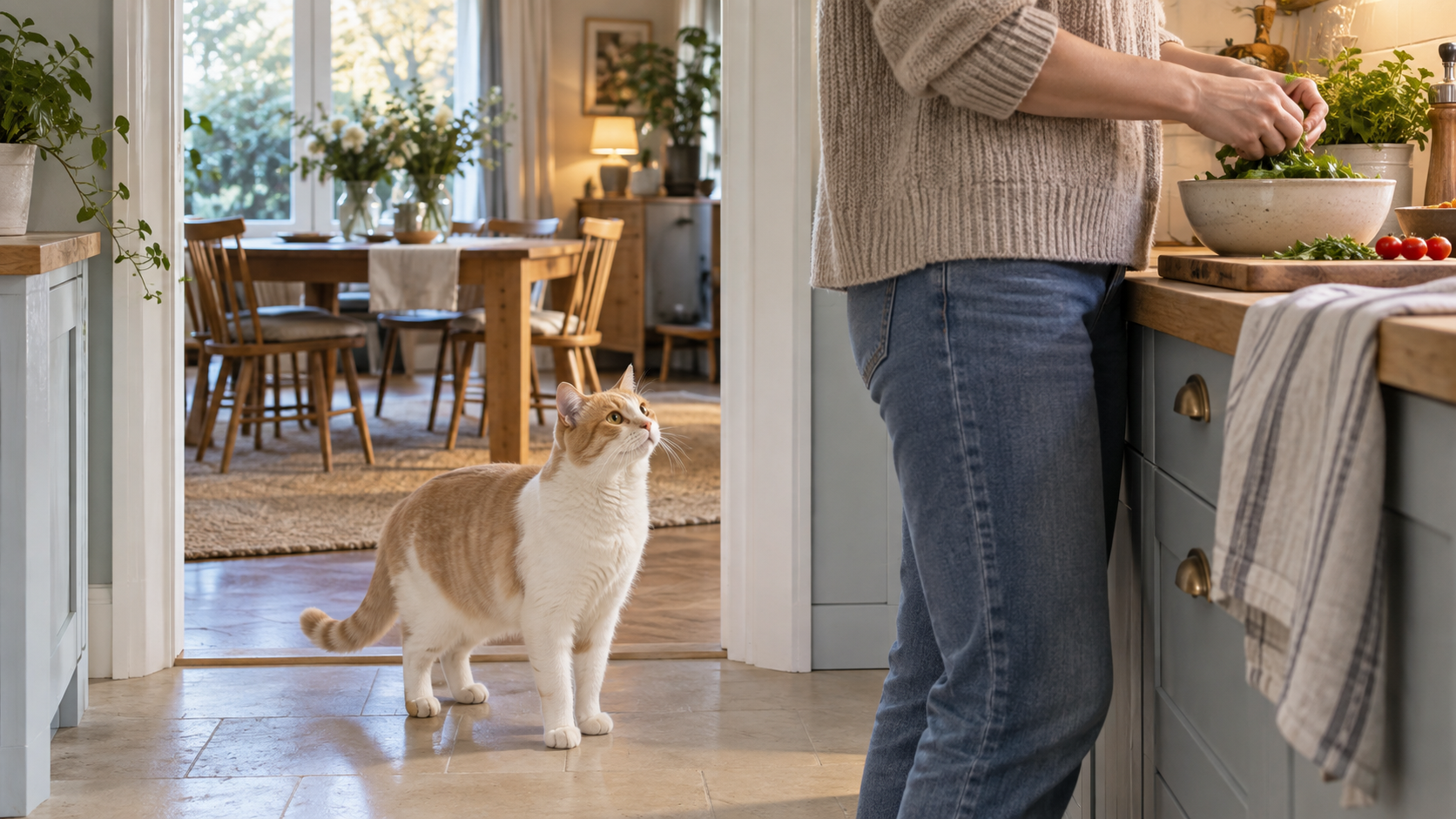
The kitchen carries strong cues: food smells, bowls, packaging sounds, and regular meal times. Following there may be a learned request, curiosity, or social interest. Check what happens at the destination rather than assuming that every kitchen escort means hunger.
The bathroom
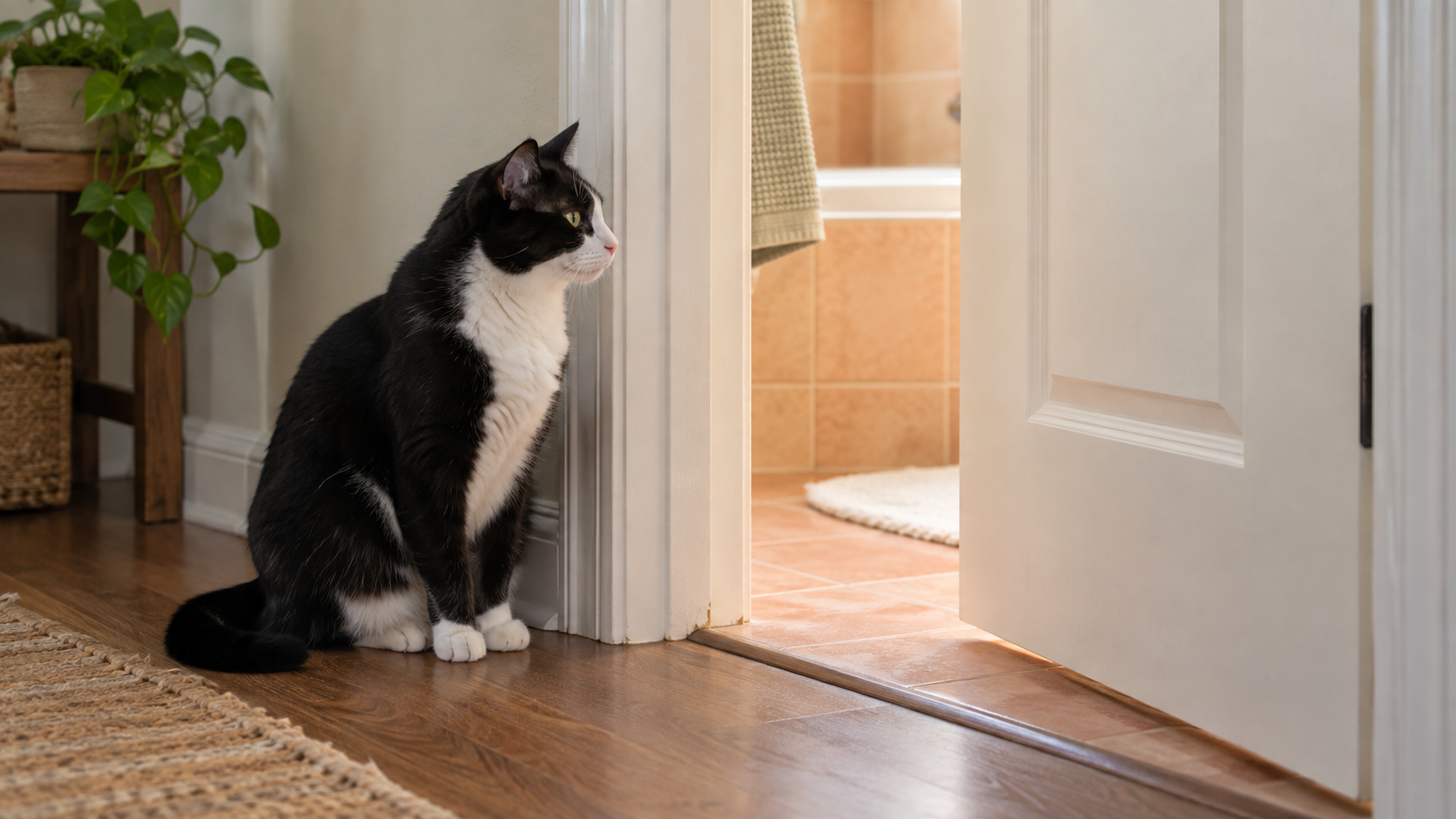
A bathroom combines a closed door, running water, unusual sounds, and a pause in your movement. A cat may wait outside because access is restricted or because the routine is predictable. If the cat waits calmly and returns to a normal activity afterward, the behavior may simply be part of the household sequence.
The bedroom
Bedrooms offer warmth, familiar scent, quiet, and a long period when a person is still. A cat who follows you to bed may be choosing the location as much as choosing your company. Notice whether the cat sleeps, grooms, or settles normally once there.
The home office
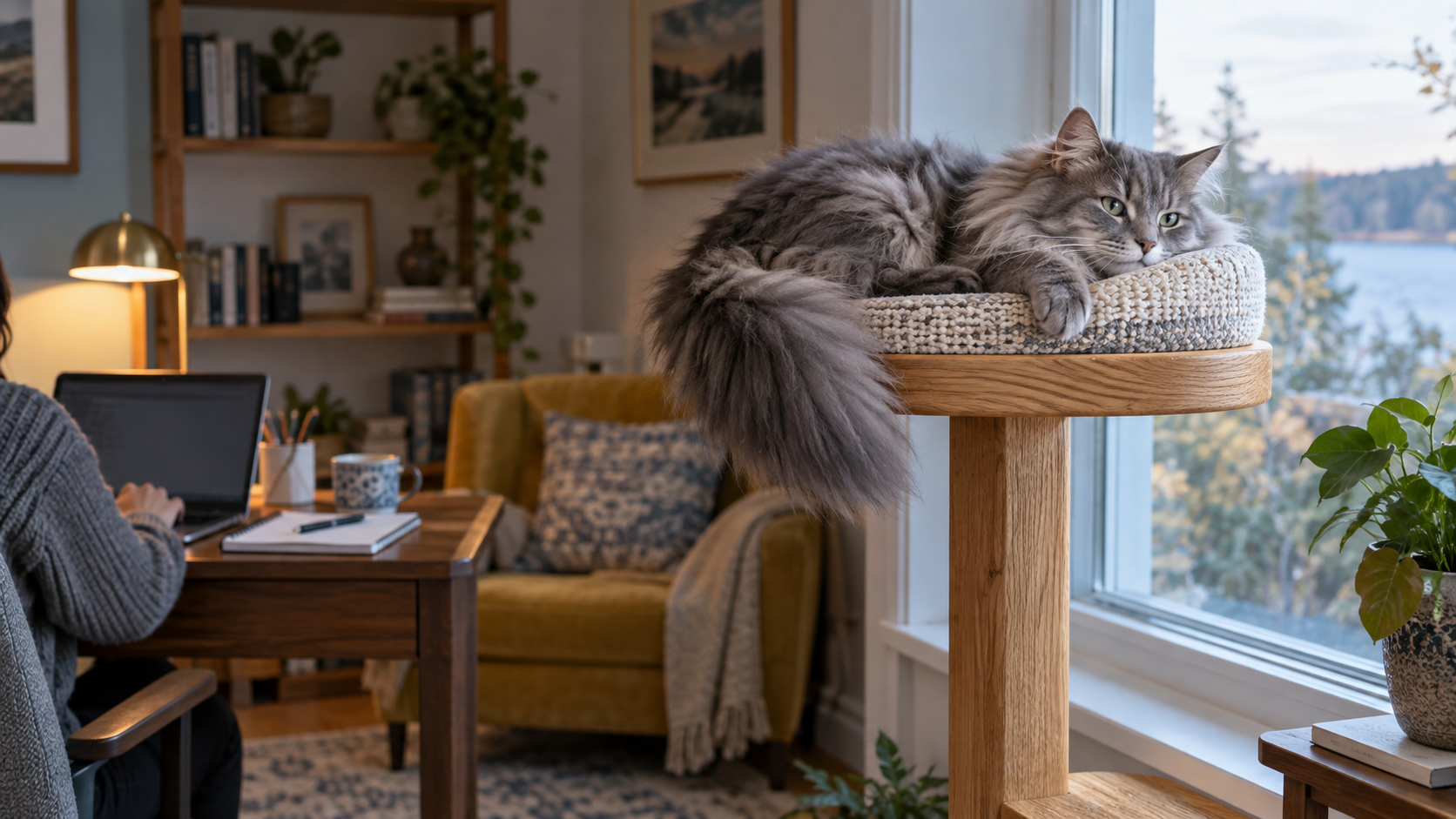
When you work, your cat may be responding to the long stretch of stillness, a warm laptop area, or the fact that you are finally in one place. A nearby perch or bed can let the cat share the room without needing constant interaction.
5. Following does not automatically mean “clingy”
“Clingy” describes how intense the behavior feels to a person; it does not explain why it is happening. A cat who follows frequently but can eat, drink, sleep, groom, play, explore, and use the litter area independently may simply prefer a social routine.
The more useful question is whether your cat has choices. Can they rest in a separate place? Can they reach food, water, litter, scratching surfaces, and safe hiding or elevated spaces without being blocked by another pet? Can they settle when you cross the room? Can they disengage after the expected meal or play session?
The Feline Veterinary Medical Association recommends environments that provide safe places, separated resources, opportunities for play and predatory behavior, positive and predictable human-cat interaction, and respect for a cat’s senses. Read its indoor-cat position statement for the broader framework. The goal is not to force a cat to be independent; it is to give the cat more than one comfortable choice.
What one study can—and cannot—tell us
In a 2024 study using a secure-base test, researchers compared owned and shelter cats during brief presence, separation, and reunion episodes in an unfamiliar setting. The cats showed affiliative behaviors toward people, including proximity maintenance and rubbing, with differences between the groups. The PubMed record is useful because it gives evidence that cats can use human proximity in a stressful or unfamiliar context.
It does not prove that every cat who follows a person at home is anxious, and it does not reduce a complex relationship to one behavior. Good pet writing keeps that distinction visible: research can illuminate a pattern without deciding what an individual cat feels in every room of the house.
When a sudden change deserves attention
If your cat has always followed you, frequency alone is not a reason to panic. If your cat begins following you suddenly and cannot settle, compare the new pattern with the rest of the day. Note changes in appetite, thirst, weight, movement, posture, grooming, sleep, vocalizing, litter-box use, awareness, or response to touch. Also note household events such as a move, construction, new pet, new person, schedule change, conflict, or loss of a familiar safe place.
Merck Veterinary Manual guidance on feline behavior emphasizes the age of onset, frequency, intensity, what happens before and after the behavior, the daily schedule, the environment, and possible medical causes. Its behavior diagnosis guide explains why a behavior should not be diagnosed in isolation.
Contact your veterinarian when the change is persistent, intense, or paired with physical or behavioral signs. Do not assume that a new shadow is simply separation anxiety, aging, or a need for more treats. Following cannot identify the cause by itself, but it can be a useful observation to include in a wider history.
How to respond without punishment
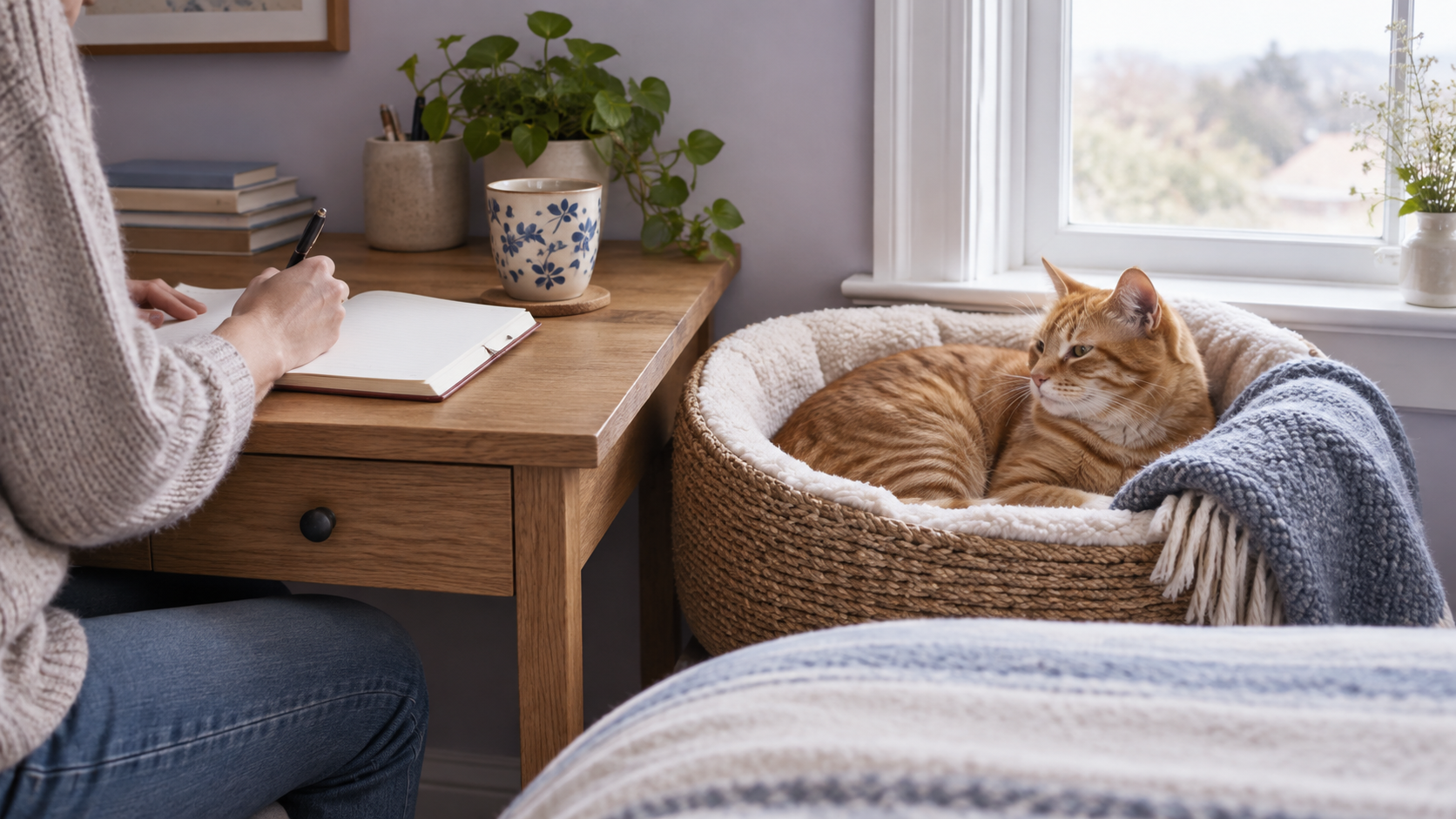
Start with observation. For several days, write down the cue, the following, the destination, what response usually happens, and whether your cat settles afterward. This simple record can show whether the behavior follows meals, doors, work, bedtime, attention, or an environmental change.
Then make low-pressure adjustments:
- Keep meals, play, and calm social contact reasonably predictable without making the schedule rigid.
- Offer a safe resting place nearby, plus a separate perch or hiding option so the cat can remain connected without being handled.
- Add short opportunities for play, foraging, scratching, climbing, and observation that suit the individual cat.
- Reward a calm alternative—such as settling on a bed—rather than scolding the cat for walking behind you.
- Change one part of the routine at a time and watch whether the cat can return to normal eating, grooming, rest, and exploration.
International Cat Care notes that routine and predictability can reduce distress, while changes in routine behavior can reflect emotional change or health problems. Its cat-friendly clinic guide also reminds caregivers that cats may hide pain or illness. If the pattern is new or worrying, environmental support and veterinary advice belong together.
The small details are the relationship
Maybe your cat follows you only when you put on slippers. Maybe they appear at the bathroom door, wait beside the kettle, or move to the same sunny patch after you sit down. These details are more personal than a generic label like “clingy.” They show the ordinary choreography that makes one cat recognizably the cat your family knows.
If a particular photograph already holds that expression, posture, ear angle, or familiar marking, it can also serve as a reference for a custom pet sculpture. Tiny Presence creates one-of-one full-color sculptures from approved pet photos and provides a digital preview before physical production. If that feels meaningful for your story, see the complete custom pet sculpture page; the behavior guide itself should remain useful even if you never order anything.
Frequently asked questions
Why does my cat follow me everywhere but not want to be held?
Following can be a way to share space while keeping control over touch. Look for relaxed movement, normal routines, and the ability to settle nearby. Cats have individual preferences for petting, grooming, being picked up, and sitting on a lap; proximity does not require physical contact.
Why does my cat follow me and meow?
Notice the timing, destination, and result. Meowing before dinner may be a learned request; meowing at a closed door may be about access or attention. New or persistent vocalizing, especially with appetite, sleep, movement, or litter changes, should be discussed with a veterinarian.
Why does my cat follow me to the bathroom?
The bathroom can be interesting because the door closes, sounds change, and your movement pauses. A cat who waits calmly and returns to normal activity afterward may simply be following a predictable routine. Frantic scratching, distress, or a sudden change needs a wider look.
Is my cat following me a sign of separation anxiety?
Not by itself. Following has several possible explanations, and the behavior alone cannot diagnose anxiety. Consider whether your cat can settle, eat, play, groom, and use resources independently, and whether anything changed recently. Seek veterinary or qualified behavior advice for a persistent sudden pattern.
How can I make my cat less dependent without hurting our bond?
Do not punish, chase, spray, or force isolation. Provide predictable contact, safe places, independent enrichment, and calm alternatives. Build one small change at a time while observing whether your cat remains comfortable. If the behavior is new or accompanied by other changes, start with a veterinary assessment rather than a stricter training plan.
Closing
A cat who follows you from room to room may be asking for dinner, checking a new sound, following a well-known routine, or choosing the comfort of shared space. Sometimes it is all of those things across the same day. Read the sequence, preserve your cat’s choices, and pay attention when the pattern changes. For more reader-first stories about the animals who shape a home, visit the Tiny Presence blog. The most loving answer is not the most dramatic one; it is the answer that leaves room for the individual cat in front of you.