There is a particular kind of silence to a Maine Coon’s companionship. One moment you are answering an email; the next, a large, soft-footed cat is beside you, quietly checking what you are doing. They can feel less like a visitor in the house than a presence that has always belonged there.
That feeling makes the breed’s history especially easy to romanticize. Stories about raccoons, ships, and queens are memorable—but memorable is not the same as documented. So where did Maine Coon cats really come from? The careful answer begins in nineteenth-century New England, among working cats that lived close to farms, homes, harbors, and people. From there, the trail leads to early cat shows, a famous 1895 record, and an archive that tells us a great deal without telling us everything.
The short answer: where did Maine Coon cats come from?
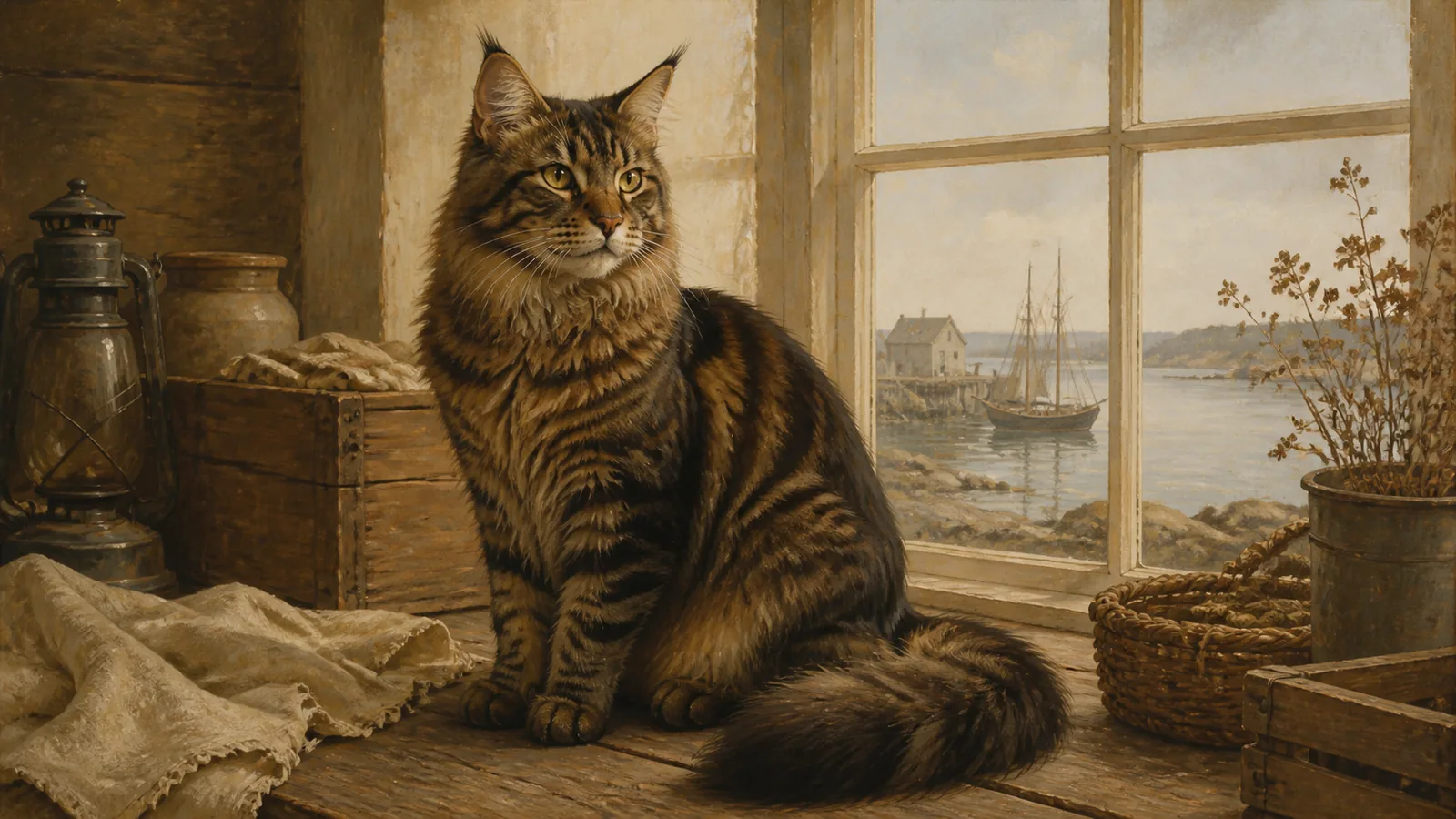
The Maine Coon developed in New England over time. The Cat Fanciers’ Association places the documented story as far back as the 1850s, when long-haired cats were already being noticed in Maine and nearby communities. The International Cat Association likewise describes a breed shaped in the region rather than founded by one clearly identified pair.
That distinction matters. The historical record does not give us a single verified “first Maine Coon.” It gives us a regional population of useful, long-haired cats and a gradual process of recognition. Some lived around farms and homes; others were associated with coastal life and ships. Over generations, people noticed the cats that could thrive in a demanding climate and live comfortably alongside human work.
A New England cat before the pedigree
Before modern breed registries and carefully managed pedigrees, a cat’s value was often practical. A good working cat was expected to live close to people without needing constant attention, move confidently through a working environment, and earn its place by keeping watch over food stores and outbuildings.
That does not mean every early Maine Coon performed the same job, or that one task created the breed by itself. It does explain why the breed’s history feels tied to ordinary places rather than a single royal kennel. Maine’s own historical resource describes the cats in the context of nineteenth-century working life, cold weather, and snowy surroundings. The setting helps explain the story; it does not replace the missing pedigree records.
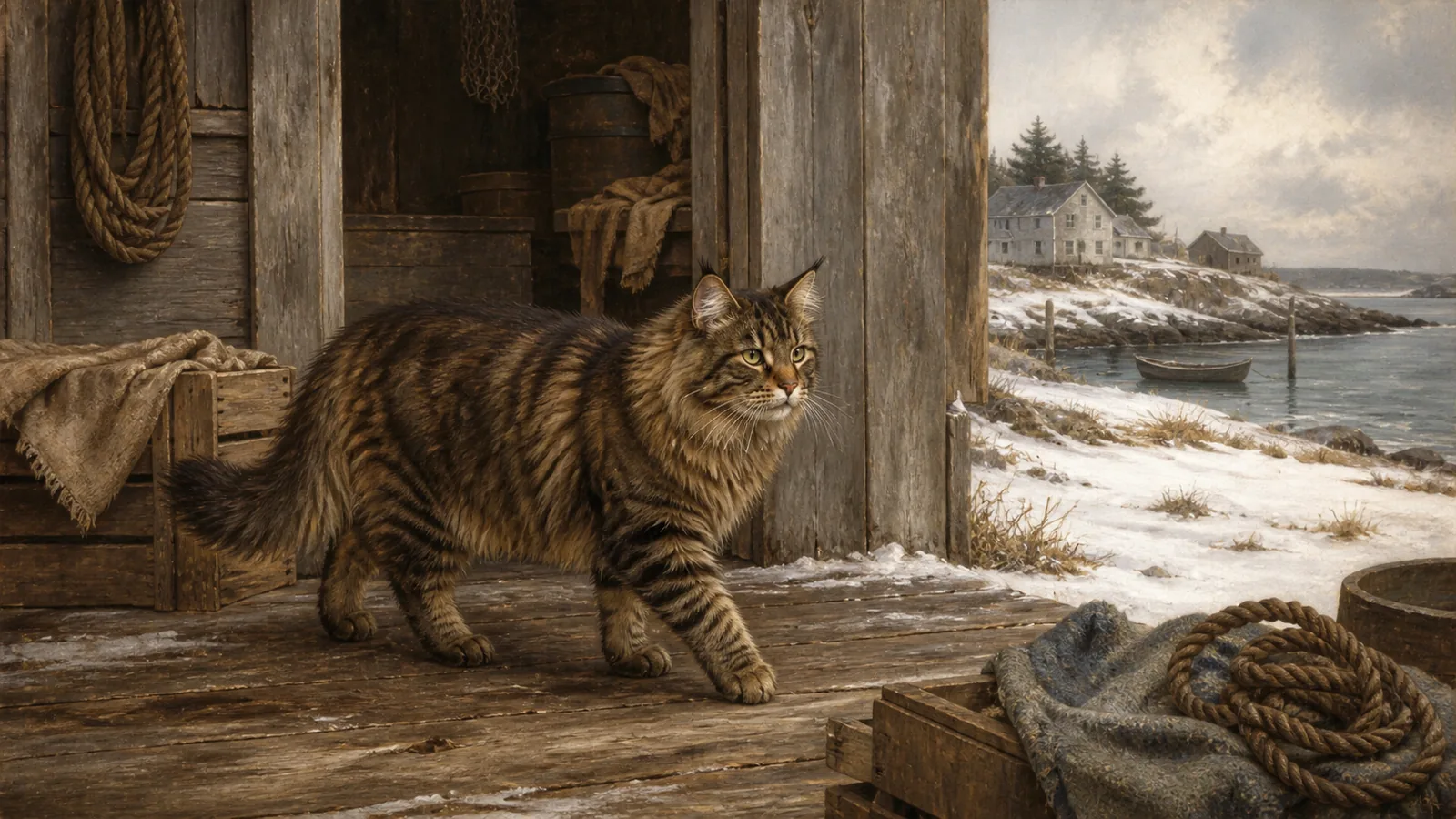
The physical image people associate with the breed also grew more distinctive with time: a long coat, a substantial frame, a full tail, and paws that look made for more than a polished living room. Those features are part of the breed’s recognizable appearance today. They should not be used to reverse-engineer an exact undocumented ancestry from a modern photograph.
Why the Maine Coon origin story is full of legends
When an origin has gaps, people fill them with stories. Maine Coon legends are not random; they are attempts to explain a cat that looks unusually large, carries a dramatic coat, and belongs to a place shaped by the sea.
The raccoon story
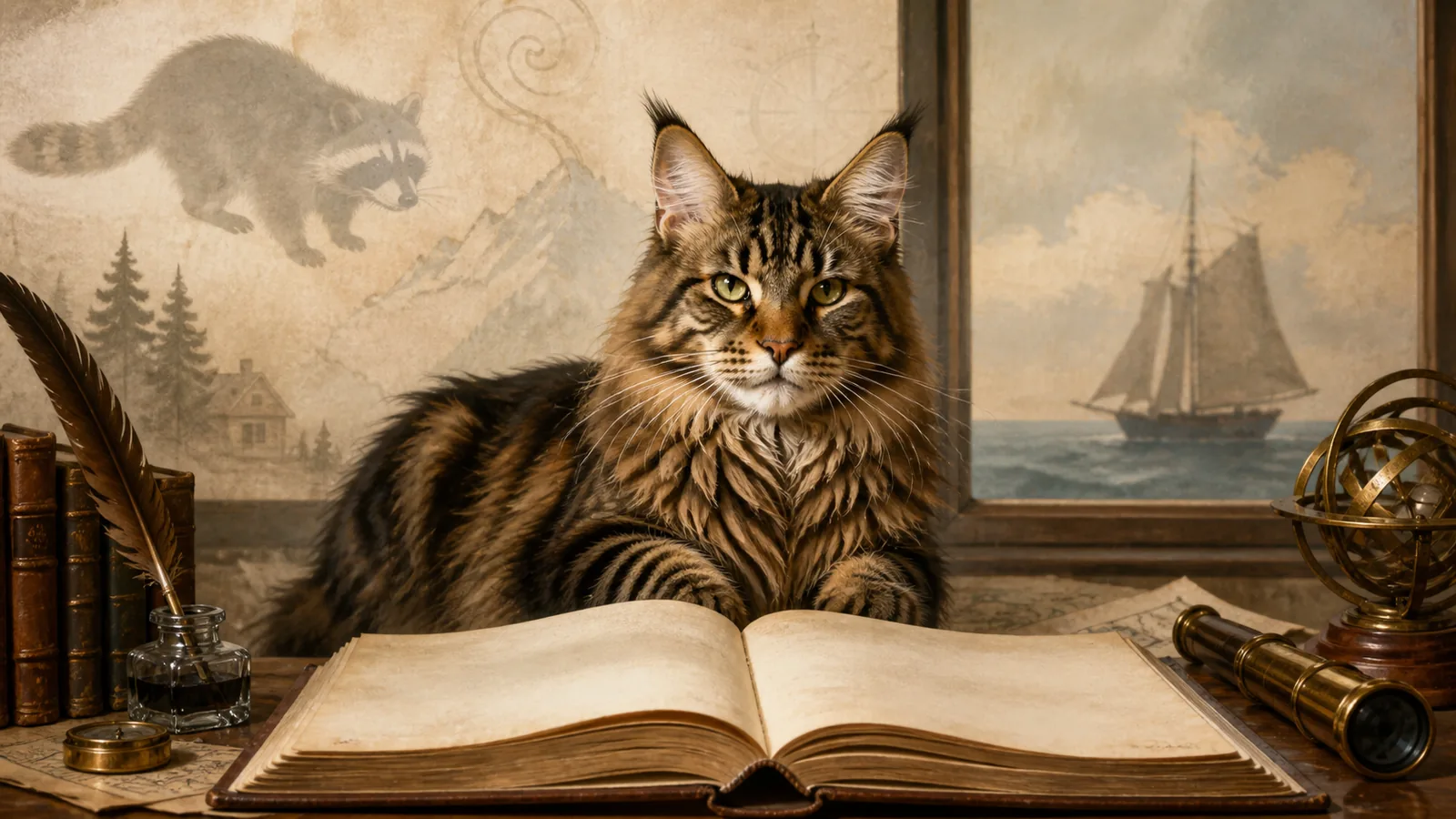
The best-known legend says that Maine Coon cats descended from raccoons. The tail and the name make the story easy to remember, but it is not a biological origin. As the CFA explains in its historical account, raccoons and domestic cats belong to different genera and cannot produce a hybrid litter.
There is no need to make the legend the villain. It is a charming piece of folklore, and folklore is part of how communities give a local animal a larger-than-life identity. It simply belongs in the “story” column, not the “documented ancestry” column.
The ship and Marie Antoinette stories
Other accounts connect the breed to cats carried on ships or to long-haired cats supposedly sent from France while Marie Antoinette planned an escape. Ship cats are a plausible part of New England’s cultural setting, but a plausible setting is not proof that a particular voyage created the breed. The Marie Antoinette account is a dramatic legend, not a verified foundation record.
The most honest version of Maine Coon history can hold both things at once: the legends are meaningful because they express what people find distinctive about the breed, while the evidence points to a slower regional development among cats already living in New England.
From local working cat to early show favorite
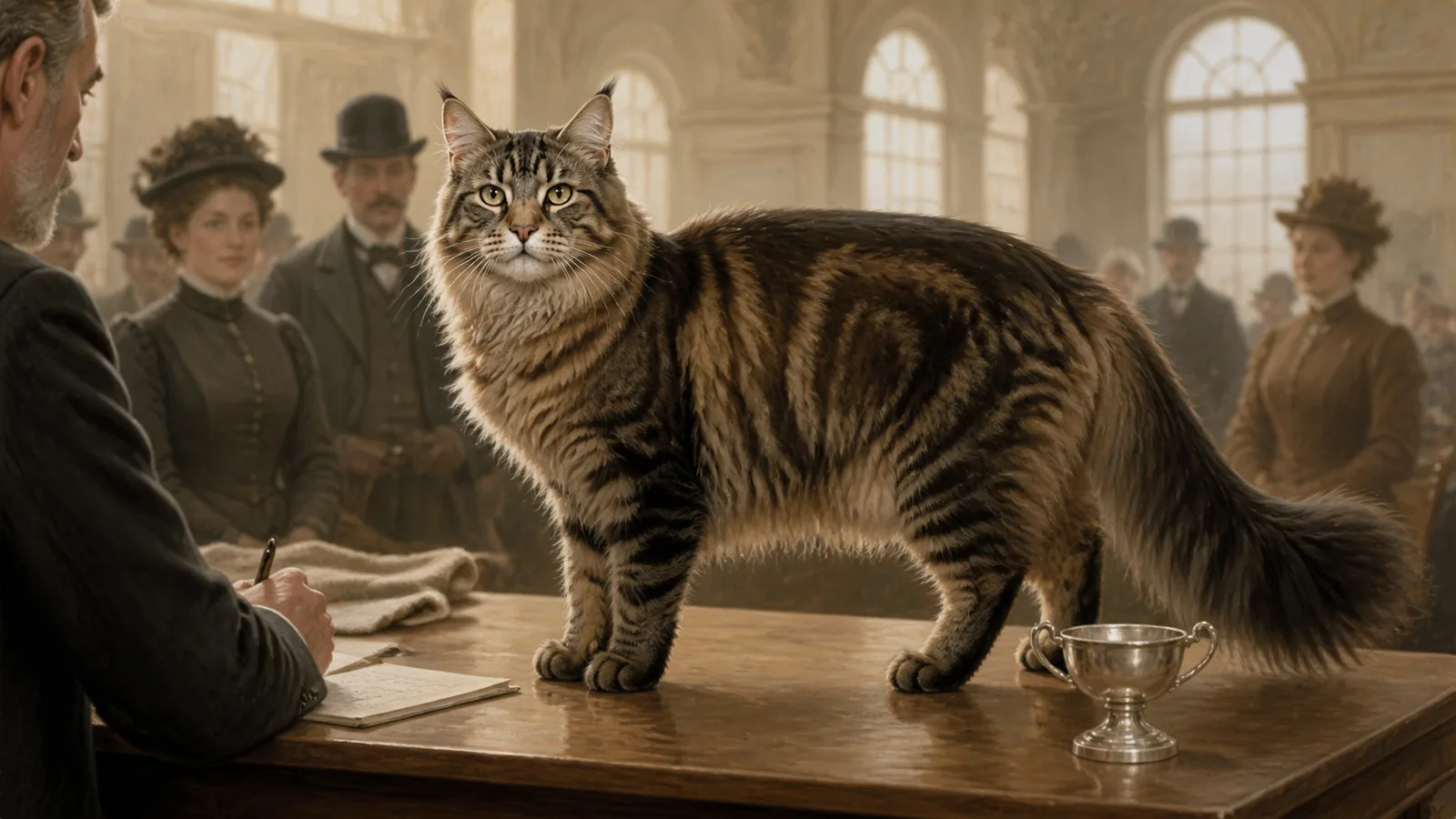
By the late nineteenth century, Maine Coon cats were no longer known only in working settings. They were becoming visible in the new world of organized cat shows. The CFA’s historical account mentions a Maine Coon called Captain Jenks of the Horse Marines in 1861 and records the breed’s appearance at a Boston show in 1878.
The most famous early show story concerns Cosey, a tabby Maine Coon associated with the 1895 Madison Square Garden show in New York. According to the CFA’s account, Cosey won that show and received a silver medal and collar commemorating the event. That moment did not create the breed. It did something just as important for its public history: it gave a regional working cat a place in the record that audiences far beyond Maine could see.
What the early records can—and cannot—tell us
Records change the shape of a story. They can anchor a name to a year, show that a cat was exhibited, and reveal when a breed began to receive formal attention. They cannot always recover the lives of every animal that came before the record-keeping began.
That is why claims about Maine Coon ancestors should be handled with care. The available histories support New England roots and a working-cat context. They do not support a neat list of exotic founder breeds presented as settled fact. The story is stronger when it admits the open space in the archive instead of decorating that space with certainty.
The breed’s cultural status continued to grow. TICA notes that Maine designated the Maine Coon as its official state cat in 1985. That designation reflects the breed’s close connection to the state and its identity—not a claim that every detail of its early ancestry has been recovered.
What history can explain about a Maine Coon today
Breed history can make familiar features feel newly legible. The heavy coat, broad paws, full tail, and confident presence fit the image of a cat shaped in a cold, working region. The history also helps explain why people describe the Maine Coon as a “gentle giant”: the phrase captures the contrast between an imposing appearance and the quiet companionship many families recognize.
But history is context, not a personality test. It cannot promise that every Maine Coon will be outgoing, calm, vocal, playful, or interested in the same routines. A breed’s past may influence the range of traits people value and preserve; it does not replace the individual cat in front of you.
The history your family remembers is more specific
The public Maine Coon story lives in breed-club archives, show reports, state records, and the legends people kept repeating until researchers compared them with the evidence. Your cat’s history lives in smaller details: the place they wait when you come home, the way their tail appears around a doorway, the particular expression your family can recognize from across the room.
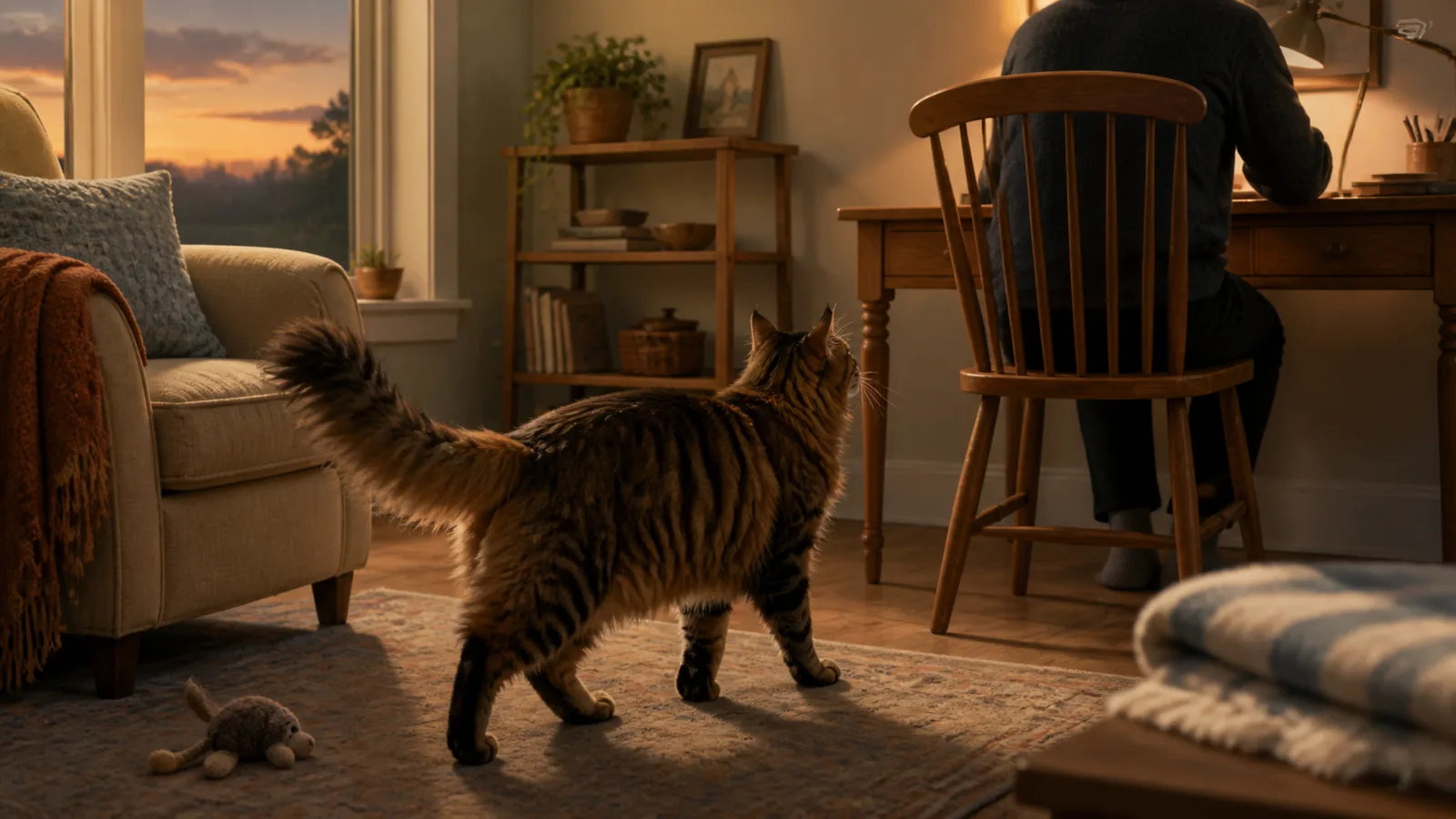
Those details are what turn a breed into a relationship. If a meaningful photograph preserves the posture, expression, or quiet habit that makes your cat unmistakably yours, Tiny Presence can use that photograph as visual reference for a custom pet sculpture. The goal is not to make a generic Maine Coon. It is to keep the individual presence your family actually knows.
Maine Coon history: quick answers
Where did Maine Coon cats originate?
The breed developed in New England, especially Maine and nearby communities. The documented history reaches back to the nineteenth century, while the exact ancestry before formal records is not fully known.
Are Maine Coon cats descended from raccoons?
No. The raccoon explanation is folklore, not biology. Raccoons and domestic cats cannot produce a hybrid litter.
What is the 1895 Maine Coon story?
A brown tabby female Maine Coon named Cosey won the 1895 Madison Square Garden cat show, according to the CFA’s historical account. The surviving record is an early public milestone, not the breed’s single point of origin.
Why are Maine Coon cats called gentle giants?
It is a popular phrase for the contrast between the breed’s large, striking appearance and the affectionate, companionable image many people associate with Maine Coons. It is a nickname, not a guarantee of an individual cat’s temperament.
A breed history that leaves room for one cat’s story
Maine Coon history is compelling because it is both grounded and unfinished. The records lead us to New England working cats, early show rooms, and Cosey’s place in the public story. The legends explain why the breed captured people’s imagination. The gaps remind us not to mistake a beautiful explanation for a proven one.
And then there is the cat beside you—the one whose history is not written in a registry. It is written in ordinary evenings, familiar footsteps, and the small rituals that make a home feel inhabited. The breed may have begun as a New England story. Your Maine Coon’s most important chapter is the one your family is still living.