You are halfway through explaining to the cat why the door must stay closed when you realize you are delivering a full argument to someone who will not answer in words. Later, the dog gets a detailed account of where the keys were hiding. Is that habit silly, meaningful, or useful—and how much are they actually taking in? Talking to pets is a common form of everyday social contact. Research suggests dogs and cats can notice parts of it: familiar voices, sound patterns, names, relevant words, and the tone people reserve for them. This article separates those signals from the tempting idea that a pet understands every sentence, and explains what our small household conversations reveal about living together.

Why do we talk to our pets?
People talk to pets because speech is one of the ways humans organize attention, routines, and relationships. A dog or cat does not need human grammar to participate. A glance, ear turn, approach, retreat, tail movement, or vocalization can keep an exchange going. The best evidence supports attention, learned associations, and recognition of familiar patterns—not mind-reading or full comprehension of a human story.
That distinction matters. It leaves room for the real pleasure of telling a cat about the mail or asking a dog whether it is finally time for a walk, without turning a response into a claim the science cannot support.
Researchers are beginning to listen to ordinary pet talk
Much of the older research on speech and pets took place in a laboratory or during a structured task. A 2026 University of Arizona team approached the subject from another direction. The researchers developed AURAL-Pet, a coding system for short recordings of human interactions with dogs and cats in daily life. They applied it to 5,072 audio clips containing evidence that a pet was present, drawn from 240 participants across four earlier studies.
The system marks whether someone is talking to a pet, asking a question, giving a command, using a nickname, changing pitch, speaking more slowly, or narrating as if the animal were a human conversation partner. In the clips, people narrated their own actions and thoughts, described what the pet was doing, and talked about weather, errands, and future plans. In other words, the ordinary monologue many owners recognize is now something researchers can measure rather than merely joke about.
The study was a methods paper, not proof that talking to a pet causes better health, creates a stronger bond, or makes the animal understand more words. Its contribution is more modest and useful: it gives future studies a way to compare the texture of real household interactions while reducing reliance on owners’ memories.
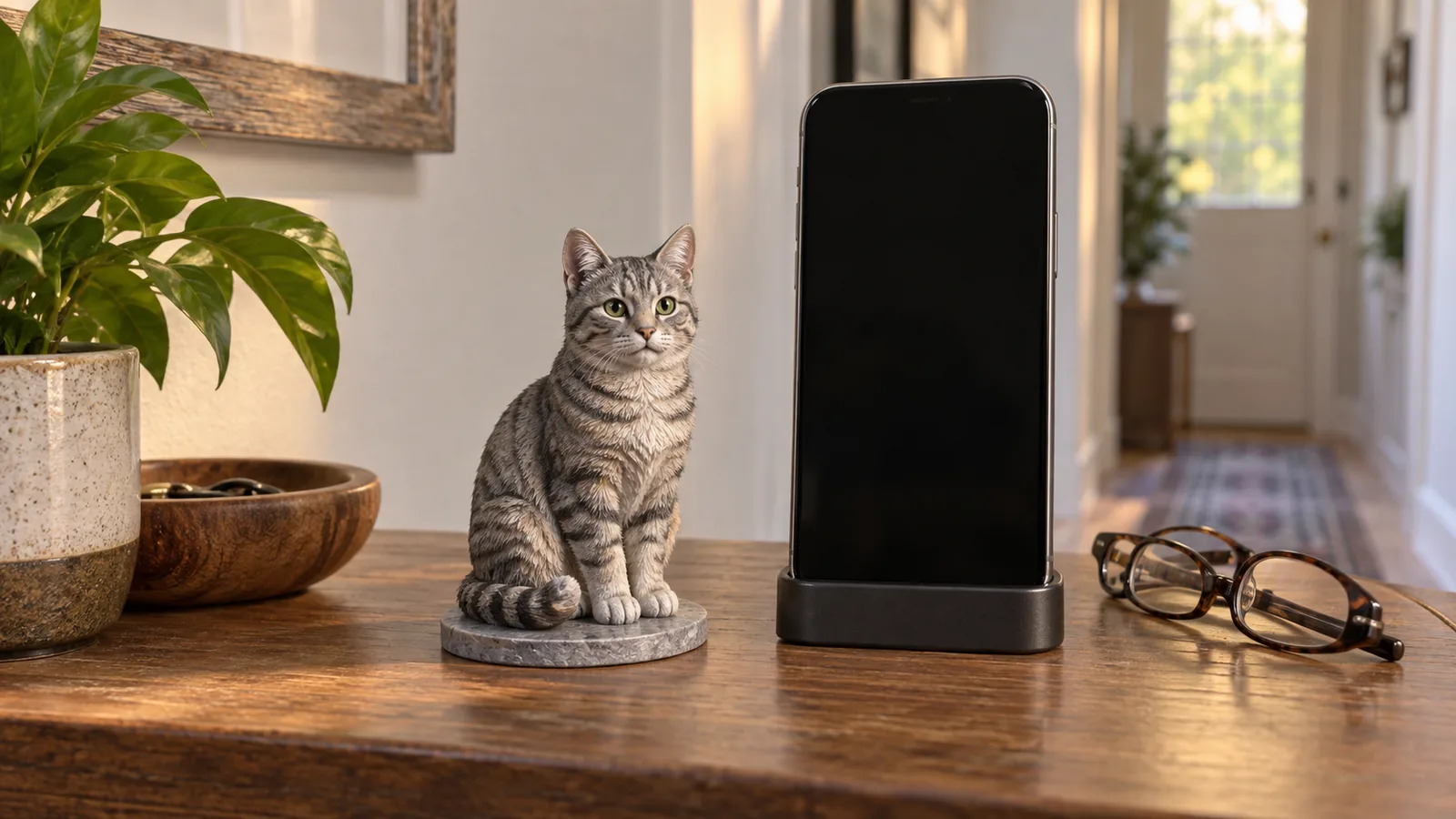
The expressions that answer these little monologues—an ear turn, a waiting sit, a slow blink—are often the same individual details people hope to preserve in a custom pet sculpture, but the everyday exchange has value on its own.
What changes when humans use “pet-directed speech”?
People often shift into a recognizable speech register around animals. Researchers call it pet-directed speech. Compared with ordinary adult-to-adult conversation, it may include a higher or more variable pitch, slower timing, stretched vowels, repetition, shorter phrases, and warmer emotion. Not every person uses every feature, and the 2026 AURAL-Pet paper notes that the field still lacks one universally agreed definition.
That voice is not necessarily fake or childish. It can be a spontaneous way to signal, “This is for you.” The important question is not whether humans sound different—we often do—but what an individual animal attends to in a particular setting.
What dogs may notice: tone and relevant words together
Dog studies offer a useful caution against one-sentence conclusions. In a 2017 playback study, puppies reacted more strongly to dog-directed speech, while adult and older dogs did not show the same preference when they heard speech without other social cues. The researchers suggested that people may keep using the register with adult dogs because it is a natural way to address a nonverbal listener, not because pitch guarantees a response.
A 2018 study using more naturalistic speech and an in-room speaker found that adult dogs paid more attention and showed more affiliative behavior toward dog-directed speech than adult-directed speech. When the researchers mismatched the tone and the dog-relevant content, the preference disappeared. Their careful interpretation was that the combination of delivery and relevant words may matter.
These experiments do not show that every dog prefers a high voice or understands a complete sentence. They show that attention depends on context, content, acoustic cues, age, prior experience, and the design of the test. Your dog’s familiar routine with you adds another layer that a recording from a stranger cannot fully reproduce.

What cats may notice: who is speaking matters
Cats are not simply smaller, quieter dogs, and the evidence base is thinner. A playback study of 16 companion cats compared speech directed toward cats with ordinary adult-directed speech. The cats discriminated between the two when their own owners were speaking. They did not show the same discrimination when the voice belonged to a stranger.
The sample was small, so this is not a rule for every cat. It does support a familiar possibility: the private way you speak to your cat may gain meaning through repeated one-to-one experience. The finding is about discrimination—detecting that the sound pattern has changed—not evidence that the cat decoded the sentence.
Other experiments have found that domestic cats can distinguish their own names from similar words, even when an unfamiliar person speaks. That does not give cats a human vocabulary. It shows that a sound can become behaviorally important through exposure, especially when it repeatedly predicts attention, food, play, movement, or another relevant event.

Attention is not the same as understanding every word
| What you observe | What the evidence can support | What it does not prove |
|---|---|---|
| Your dog turns toward a warm, animated voice | Speech pattern and dog-relevant content may attract attention | That the dog understands a long sentence or agrees with it |
| Your cat reacts differently when you use your “cat voice” | A familiar owner-specific speech pattern may be recognizable | That every cat prefers the same pitch or tone |
| Your pet responds to a name or routine word | That sound may have become meaningful through repeated experience | Human-like grammar or an unlimited vocabulary |
| You narrate plans, chores, or the weather | Naturalistic recordings show that people do this in daily life | That monologues automatically improve human or animal wellbeing |
| A veterinarian addresses your pet directly | Many surveyed owners value a pet-centered communication style | That voice alone changes a medical outcome or removes stress |
The middle ground is more interesting than either extreme. Pets are not blank listeners, but neither are they tiny humans translating paragraphs. They learn regularities in a shared environment. Owners learn the timing, posture, sounds, and choices of an individual animal. Conversation sits inside that larger exchange.
How to make your words clearer without flattening the relationship
Use consistency when you expect an action
If a phrase is meant to guide behavior, keep the important cue short and consistent. “Mat,” “outside,” or a pet’s name is easier to pair with one predictable outcome than with a different paragraph each time. Reward the response you want with something the animal values. The American Veterinary Society of Animal Behavior recommends reward-based methods and advises against aversive training.
Keep the long stories for connection, not instruction
There is no need to stop telling your pet about the day. Just separate that pleasure from a cue that needs to be clear. A long explanation may be meaningful to you and socially engaging for both of you even when most of its words are not decoded.
Let body language answer
A pet can orient toward you, remain loose and settled, approach, move away, hide, stiffen, flatten the ears, swish the tail, or end the interaction. Veterinary behavior guidance emphasizes watching dogs’ and cats’ body language because it carries information about their state. If the body says “enough,” a sweeter voice does not turn continued handling into consent. Pause and give space.
Match the voice to the moment and the individual
An upbeat greeting may suit a relaxed dog who enjoys it and be too much for an anxious animal in a confined space. A cat may notice its owner’s private speech pattern but ignore the same tone from a visitor. Familiarity and context matter more than performing a universal “pet voice.”

Why it matters when a veterinarian talks to the animal, too
A 2026 survey of 400 pet owners found that almost 80% recalled veterinarians using pet-directed speech, and nearly 90% said they would be more likely to return to a veterinarian who used it. Respondents associated the behavior with keeping the pet at the center, communicating beyond words, including the owner, and forming an impression of the clinician.
The study used online snowball sampling, so its percentages should not be treated as a universal vote from all pet owners. It measured owner perceptions rather than animal stress or treatment outcomes. Still, it reveals something important about the human side of the bond: addressing the animal can show the owner that the patient is being regarded as an individual, not as luggage at the end of a leash or inside a carrier.
The household character lives in the details
Pet-directed speech rarely matters because the sentence is brilliant. It matters because it happens in the same doorway, beside the same chair, before the same evening walk. Over time, a dog’s waiting posture or a cat’s answering trill becomes part of the family’s soundscape.

A favorite photograph can hold one of those expressions. If you later want a physical keepsake, Tiny Presence can use that image as reference for a full-color custom pet sculpture. The models below are editorial examples, not customer commissions or records of specific pets.

Frequently asked questions
Is it weird to talk to your pet like a person?
No. Naturalistic research treats talking, questioning, nicknames, narration, and changes in voice as ordinary features of human–pet interaction. The habit becomes misleading only when a person assumes that the animal understands every sentence or ignores contradictory body language.
Do dogs understand baby talk?
“Baby talk” is too broad to give a simple answer. Experiments suggest that puppies and adult dogs may attend to some features of dog-directed speech, especially when an animated tone appears together with dog-relevant words. Individual dogs, contexts, and study designs differ.
Do cats know when you are talking to them?
One small study found that 16 companion cats distinguished cat-directed from adult-directed speech when their owners spoke, but not when strangers did. That supports recognition of a familiar relationship-specific pattern, not complete sentence comprehension.
Does talking to a pet make the bond stronger?
Talking may be part of an attentive, enjoyable relationship, but current evidence does not justify a guarantee that more speech automatically creates a stronger bond. The quality of the whole interaction—including predictability, reward, choice, play, care, and respect for body language—matters.
Should I use a high-pitched voice with my dog or cat?
You do not need to manufacture one sound. Use a calm, friendly delivery that suits the moment and notice how your individual pet responds. For a behavior cue, consistency and a meaningful reward are more useful than trying to copy a universal pitch.
Keep talking, and keep listening
You can keep giving the dog a weather report and asking the cat why the hallway has become a racetrack. The careful conclusion is not that they understand nothing or everything. It is that a shared life builds a communication system from voice, words, timing, movement, and memory. Talk if the exchange brings attention and warmth; then watch the ears, eyes, posture, distance, and choice that answer you.
For more evidence-led stories and guides about life with dogs and cats, visit the Tiny Presence Blog.